
notes on YC AI startup school
better late than never

2 months ago I attended Y Combinator first-ever AI startup school. While attending I wrote very long Twitter threads for each of them (see footnote for links)1. Then I flew home and continued debugging my code like any other Wednesday.
But a few days ago my friend Hoang texted me to ask about my experience. I thought it would be nice to have all the threads in one place, and also jot down a few observations that I found interesting.
1/ No one knows what’s happening.
No like seriously. Garry Tan was confessing on stage that they were not very sure if a venture capital model like YC would still be relevant in a few years (in front of all the potential YC founders, haha). Sam Altman was hyping GPT-5 intelligence, then François Chollet explained how most model benchmarks were failing to capture real-world open-ended tasks. Andrew Ng talked about how the app layer is where the money is at, then Replit CEO came into talk about how the app layer is dead, focused on agents instead. But then Andrej Karpathy’s talk was just about how 2025-2035 is the decade of the agents, which means don’t expect agents to work quite soon yet…?
By the second day I started getting used to each person coming on contradicting the first. No one knows what’s happening next. Not Sam Altman, not Andrew Ng, not any of the people who were supposed to have answers.
But the one thing everyone agrees:
2/ A new frontier cracks open.
So many of the talk starts with “Our fundamental assumptions about the world have been broken”. AI is opening a new world as we speak, daily. Between the startup school (June) and now, AI has gotten 2 gold medals in International Maths Olympiad and came second in the world at competitive programming. In other words, AI is now comparable to the best humans in the world, in some of our hardest subjects. And they are only getting better from here.
Literally, the advice most speakers give is, “build something that don’t quite work right now, because as the model gets smarter in a few months, it will suddenly start working one day.”2
There was a song from Hamilton that kept playing in my head while I was there:
Look around, look around, at how lucky we are to be alive right now.
History is happening and we just happen to be in the greatest city in the world
That’s how it felt to be in the building. It feels like being in a place eventually be part of history books some day.
3/ There were like, 0 Americans.
8 out of 10 of the people I meet at AI startup school are not from the US originally. Most came here for college, some for work some were actually just in SF for a few months. The foreigners do skew Europeans because they are the people who can get the visa most easily I guess3. The few Americans there were mostly second gens as well.
It’s funny because there was a fireside chat with the Senior AI Policy Advisor at the White House, and he kept emphasizing the whole strategy for the current Administration was American first. But … if you look at reality, the best young talents in AI are mostly not from the US. Any administrations that are serious about AI would clearly need to re-caliberate about skilled immigration.
4/ What is the use of such a conference?
You know this is one of the questions I’ve been puzzling with. It’s definitely not knowledge - most of the talks ended up on YouTube, so someone at home could watch most of the talks and get the same information.
I guess you could meet someone who would be your co-founder, but ime 2 days is too short to really get to know someone. To give credits to YC, there was good infrastructure at the conference. There’s group chats for introduction. There’s a bot that matches you with someone else going to the conference. There’s afterparty so you can get to know people on a more casual context. But at the end of the day, it’s a conference with back-to-back talks, and a lot of people. So there are just O(n^2) potential matches that would go wasted. It’s pretty hard for instance to have an interesting conversation with someone about climate and AI when everyone I talk to is building B2B SaaS Agents.4
But I do think there’s something about being in the same room with all the pioneers in the field. When Garry Tan got up on stage and said it’s time to build it hits different than if I had watched the same Youtube video in my apartment. When Elon recalled he first asked for a job at Netscape, and failing that he started Paypal, I thought huh, I guess there’s a world where Elon wouldn’t have been an entrepreneur too.
There’s something about this experience that stretches the ceiling of my dreams a bit further. For that, I’m very grateful.
5/ What’s next?
Last year when I interviewed my dad I learned about his whirlwind business time during the Internet era. He learned how to type on a computer and opened a photocopy shop. The money he made was how my parents saved up for my own education. As he told me this story his eyes glistered - it was the golden time of his life. If I look back to this era of my life, will I feel regretful being on the sideline?
It’s a question I’m not sure I have the answer to yet. Does that mean I have to start a startup? I don’t know. As of now I’m still learning a lot at our startup as we experiment with lots of AI tooling, evals, architecture building, etc. But lately I’ve been pondering about the future of AI and renewable energy, and my role in it5. If you have connections, resources, or any interesting thoughts, please send them my way!!!
On a side note, just want to flex …
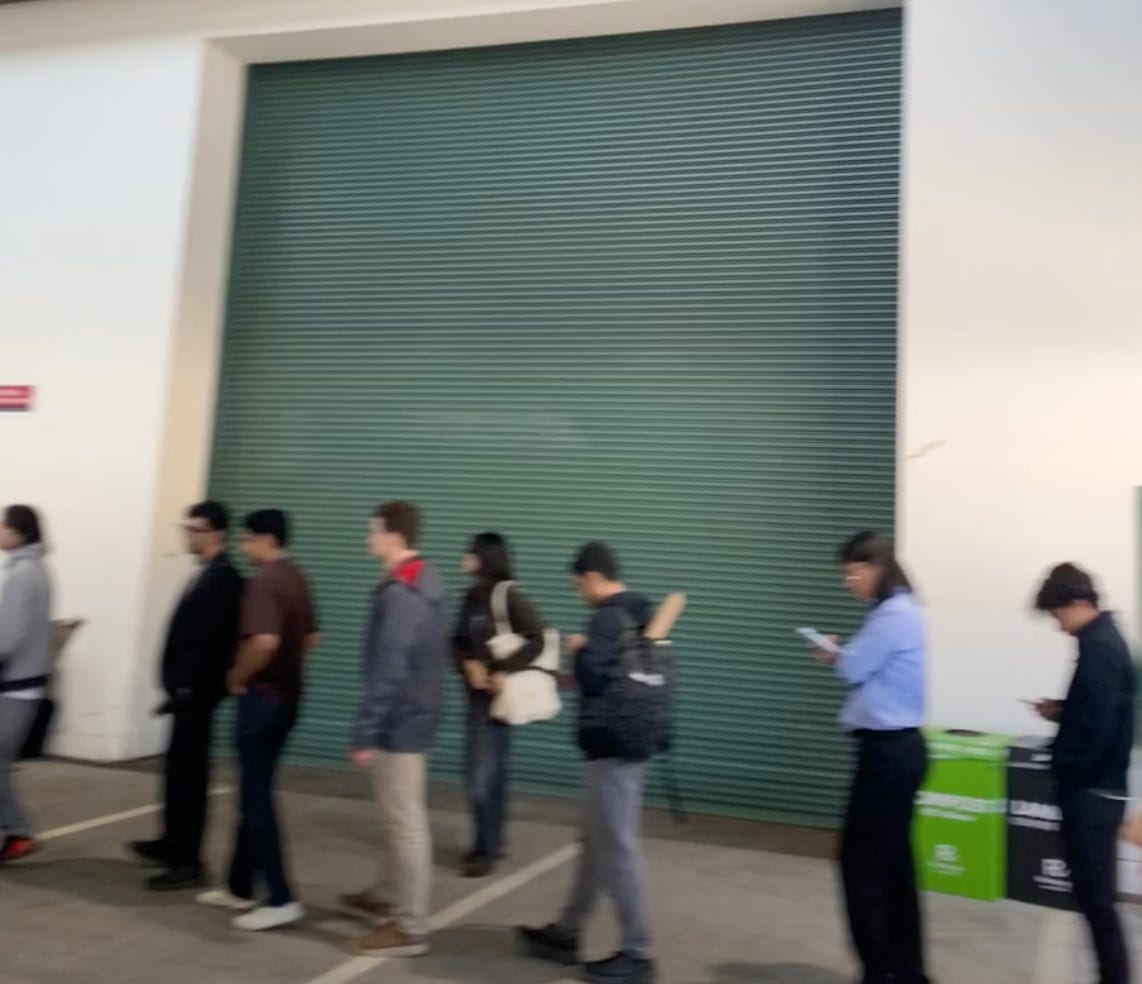
This is the first time in my life where the line to the female’s bathroom is shorter than the male’s one 😭😭😭.
Thanks to Hoang for nudging me to publish =))) this is what good friends are for.
This completely maps out with my own experience building for Topos. We were banging against the walls parsing a few hundred pages of documents, trying fine-tuning, RAGs, etc. Then Claude Sonnet 3.5 came out, and everything started working overnight.
I have had friends who got accepted but couldn’t make it because applying for a visa to the US would take a few months :(
tho maybe that’s a skill issue
When a friend asked me about this, I explained my ideal role would be something like:
Michael Lai is leading AI for State & Local Governance at Anthropic, what if Anthropic opened an AI for Energy division? Who would be the lead? And what would it take for me to be the 2nd, 3rd, 4th hire?
this made me think 🤔 thank you for sharing!! also that pic is SO FUNNY HAHA
Thanks for sharing Ha! Good to know we all are confused about what AI will become :)